The Problem Was Never the Technology
The Knowledge Distance Problem

I’ve watched organizations bolt technology onto broken structures my entire career and call it transformation.
New system. Same org. Same politics. Same distance between the people closest to the work and the people making decisions about it. The technology changed. The outcomes didn’t. Everyone moved on to the next implementation cycle and did it again.
This is not a new observation. It’s not even a controversial one. Ask any practitioner who’s been in and around enterprise organizations for more than a decade and they’ll tell you the same thing: the technology was rarely the problem. The organization was the problem. The technology just made it easier to pretend otherwise.
What’s different now isn’t the pattern. It’s the speed. And for the first time, it’s measurable in shareholder returns.
BCG published a study last September — 1,250 companies, 68 countries — that put a financial value on the organizational readiness gap. The numbers are not incremental.
Companies that have crossed the organizational readiness threshold are generating 3.6 times the three-year total shareholder return of companies that haven’t. 2.7 times the return on invested capital. 1.6 times the EBIT margin. Not from better models. Not from larger AI budgets. From organizational posture.
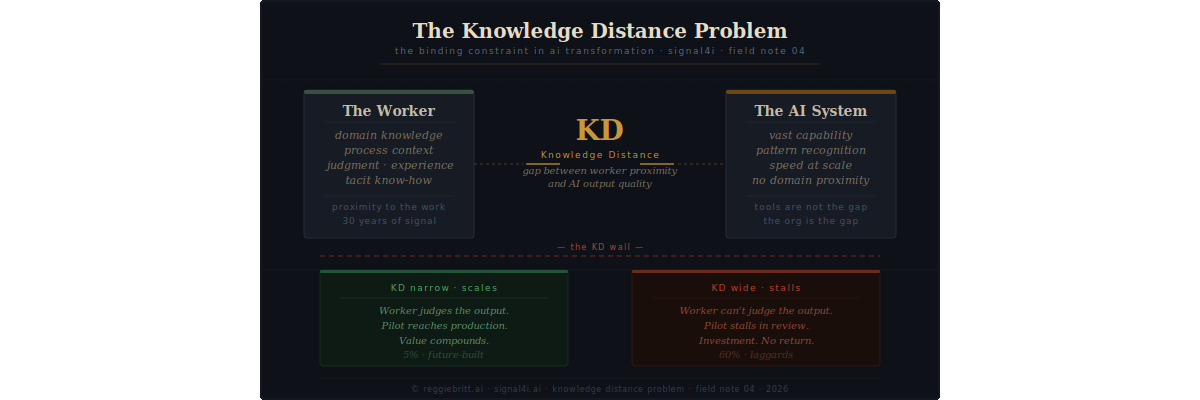
Only 5% of companies are on the right side of that gap. Sixty percent are reporting minimal revenue and cost gains despite substantial investment.
The technology is working. The organizations aren’t ready for it. I’ve seen this before. The difference is that this time, the gap shows up in the return data.
Bolting on never worked. Now it’s obvious.
Every major enterprise technology wave of the last thirty years produced the same failure mode. You could see it clearly in ERP rollouts, CRM implementations, digital transformation programs, cloud migrations. The organizations that succeeded weren’t the ones with the best technology. They were the ones that redesigned how work got done before — or at least alongside — the technology deployment.
The ones that failed bolted the new system onto the existing structure, trained people to use it without changing what they were actually doing, declared success when adoption metrics hit a threshold, and wondered two years later why the promised returns hadn’t materialized.
AI is that pattern at warp speed with the volume turned all the way up.
The acceleration changes the stakes in a way that matters. In previous waves, the gap between organizations that got it right and organizations that didn’t was meaningful but survivable. You lost some ground. You caught up in the next cycle. The compounding was slow enough that you could recover.
BCG’s data suggests that window is closing. Future-built companies — the 5% — are reinvesting their AI returns in more AI capability at a rate 120% higher than laggards. The gap isn’t stable. It’s widening every quarter. The organizations trying to close it in 2027 will face a harder problem than the organizations acting now.
The mechanism has a name.
In May I published a piece naming the binding constraint the Knowledge Distance Problem. The argument: the gap between the people closest to the work and the AI systems being asked to do that work determines whether AI scales or stalls. When that distance is too wide, pilots succeed and production doesn’t follow. The organization stays stuck — spending on tools, running experiments, reporting progress, generating almost no bottom-line value.
BCG’s survey data confirms the mechanism. They asked 1,250 executives to name their biggest barriers to AI progress. The top three: no expertise to manage unstructured data (79%), people adapting to changes and using AI daily (77%), shortage of AI talent (74%). All three significantly higher for organizations stuck at the bottom than for organizations generating real value.
Those aren’t technology barriers. They’re organizational distance barriers. The data exists — organizations can’t use it because no one has proximity to it. The people exist — they can’t change their daily patterns because the distance between old workflows and new ones hasn’t been closed. This is the same failure mode I’ve watched play out across thirty years of enterprise technology. AI didn’t invent it. AI just made the cost of it visible in the return data for the first time.
BCG has their own framing for it: the 10-20-70 rule. Seventy percent of a business’s strategic focus in AI transformation should be on people and processes. Twenty percent on technology. Ten percent on algorithms. Most organizations are doing it in reverse. They have been for as long as I can remember.
What’s actually different this time.
The pattern is the same. The speed isn’t.
Four major research organizations have now published findings that converge on the same conclusion from different angles. MIT found that 95% of AI pilots fail to scale to production. IBM’s 2026 CEO Study found that organizations redesigning work around AI earn a 17% revenue premium. Stanford HAI documented 88% adoption alongside single-digit agentic deployment rates. BCG found that 60% of companies generate no material value despite substantial investment — and quantified what that costs in shareholder terms.
Different methodologies. Same finding. The technology is not the constraint.
What’s new is that the consequence of getting the organizational side wrong is now measurable in real time, at a pace that doesn’t allow for the slow recovery that previous technology waves permitted. The 3.6x TSR gap is being set right now. The compounding is happening right now. The organizations that treat AI as a technology project instead of an organizational transformation are paying for it right now — they just may not see it clearly in the return data yet.
They will.
The problem was never the technology.
It was always the organization’s capacity to absorb what the technology made possible — to close the distance between how work was done and how work could be done, between the people making decisions and the people doing the work, between what AI can do and what the organization is ready for.
I’ve watched organizations fail to close that distance for thirty years. The tools changed. The budgets grew. The gap persisted.
What’s different now is the speed. And the price tag.
Reggie Britt tracks AI readiness signals at Signal4i and writes on strategy, organization, and the human side of AI transformation. The Knowledge Distance Problem is Field Note 04, available at signal4i.ai. The Signal Brief: Organizational Readiness Edition connects IBM’s 2026 CEO Study data to the same thesis.