After Brooks
The Knowledge Distance Problem is the new governing law of the AI economy

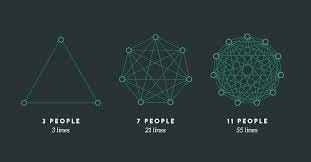
I read The Mythical Man-Month and I lived it.
Fred Brooks published that book in 1975. He wrote it out of pain — watching IBM’s OS/360 project collapse under its own weight. The insight was deceptively simple: adding people to a late project makes it later. More engineers meant more coordination cost. More coordination cost meant more drag. More drag meant slower output. The math never worked in your favor.
Brooks knew this from the inside. He wasn’t theorizing. He was watching it happen in real time on one of the most ambitious technology programs ever attempted.
I watched the same thing play out across thirty years of enterprise technology work. A project falls behind. Leadership’s instinct: add people. The result, almost without exception: the project slows down further. New people need onboarding. Existing people stop building to train them. Requirements get re-explained, misunderstood, re-explained again. The communication surface area grows faster than the output does.
The industry’s answer was to build scaffolding around it. Agile. SAFe. Cross-functional teams. Sprint ceremonies. Monitoring stacks. Requirements management tools.
All of it — every methodology, every framework, every tooling investment — was scaffolding built to manage one underlying problem: the human communication tax.
For fifty years, no one found a way through it. Brooks’s Law became the foundational constraint of every software company that followed.
Then, in 2022, something changed.
Martin Casado at a16z and Abhishek Nagaraj at Berkeley published a Fortune piece last week declaring Brooks’s Law broken. They’re right.
The tools now remember the changes. They track the requirements. They hold context across sessions, contributors, and time. The thing that made the communication tax so expensive — every handoff a lossy transfer, every new team member starting from near zero — that tax is gone.
The scaffolding built to manage the human coordination tax is no longer load-bearing.
What Casado and Nagaraj didn’t name is what’s left when you remove the ceiling and the scaffolding simultaneously.
What’s left is organizational inertia. The weight the scaffolding was also hiding.
The alibi is gone.
For fifty years, organizations could point to engineering complexity as the reason transformation was slow. When a technology initiative stalled — when a transformation program delivered less than promised — there was always a credible technical explanation. Brooks said so.
AI removed the technical constraint. What remains is the truth about organizational readiness.
The inertia was always there. The broken processes, the territorial boundaries, the undocumented decisions — they were survivable at human speed. When every initiative moved slowly by default, organizational drag was invisible.
AI runs the tape faster. And when the tape runs faster, everything that was hidden becomes visible.
You can’t hide organizational failure at AI speed.
This is the setup for what I’ve named the Knowledge Distance Problem — the framework that describes what replaced Brooks’s Law as the governing constraint of the AI economy.
Three dimensions. A diagnostic architecture. And the reason most organizations will spend the next five years buying AI products they can’t fully use.
Continue reading the full essay at reggiebritt.ai →
Reggie Britt is the originator of the Knowledge Distance Problem framework. He writes at reggiebritt.ai. Source is Sovereignty.